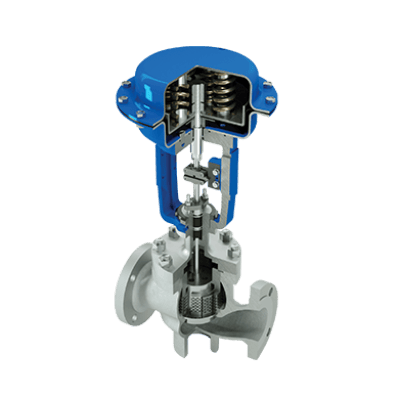
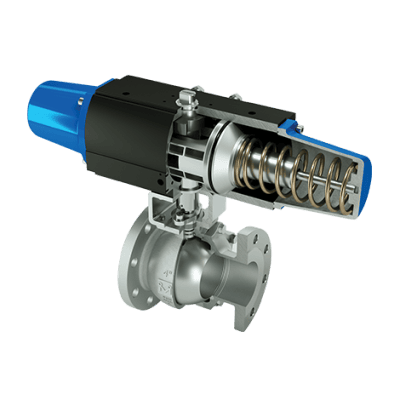
Valve actuators provide force to move control valve trim. For precise positioning of a control valve, there must be a calibrated relationship between applied force and valve position.

When a control valve is assembled from an actuator and a valve body, the two mechanisms must be coupled together in such a way that the valve moves between its fully closed and fully open positions with an expected range of air pressures. A common standard for pneumatic control valve actuators is 3 to 15 PSI or base on actuator manufacture
There are really only two mechanical adjustments that need to be made when coupling a pneumatic diaphragm actuator to a sliding-stem valve: the stem connector and the spring adjuster. The stem connector mechanically joins the sliding stems of both actuator and valve body so they move together as one stem. This connector must be adjusted so neither the actuator nor the valve trim prevents full travel of the valve trim:

Note how the plug rests fully on the seat when the valve is closed, and how the travel indicator indicates fully open at the point where the actuator diaphragm nears its fully upward travel limit. This is how things should be when the stem connector is properly adjusted.
 KOMOTO AO-3607 Control valve maintenance servicesTKLD Control Valves ServicesBall Valve Maintenance ServicesGate Valve Maintenance ServicesControl Valve Severe ServiceGlobe Control Valve Maintenance ServicesOn-Off Valve Maintenance ServicesKOMOTO AO-3841 Control valve maintenance servicesKOMOTO AO-3811 Control valve maintenance servicesKOMOTO AO-3507 Control valve maintenance services