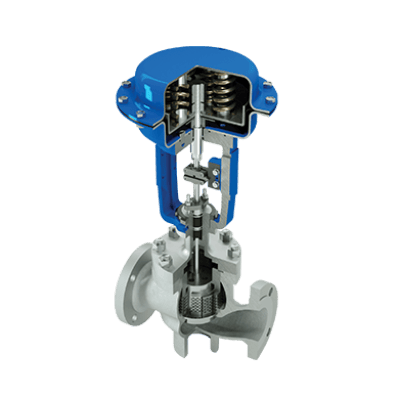
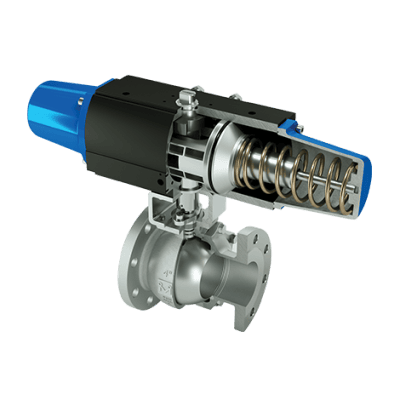
Control valves are designed to throttle flows and they are not necessary able to close 100% with no leakage.
The shut off ability has to do with type of valve. Double seated control valves have very poor shut off capabilities. In addition - the guiding, the seat material, the actuator thrust, the pressure drop and the type of fluid all play part in how well particular control valves shuts off.
There are actually six different seat leakage classifications defined by ANSI/FCI 70-2 2006 (European equivalent standard IEC 60534-4).
The most commonly used are
CLASS IV is also known as metal to metal. It is the kind of leakage rate you can expect from a valve with a metal plug and a metal seat.
CLASS Vl is known as soft seat classification. Soft Seat Valves are those where either the plug or seat or both are made from some kind of composition material such as Polytetrafluoroethylene (PTFE) or similar
Identical to Class II, III, and IV in construction and design intent, but no actual shop test is made. Cass I is also known as dust tight and can refer to metal or resilient seated valves.
Intended for double port or balanced singe port valves with a metal piston ring seal and metal to metal seats.
Typical constructions:
Intended for the same types of valves as in Class II.
Typical constructions:
Intended for single port and balanced single port valves with extra tight piston seals and metal to-metal seats.
Typical constructions:
Intended for the same types of valves as Class IV
Typical constructions:
Class Vl is known as a soft seat classification. Soft Seat Valves are those where the seat or shut-off disc or both
are made from some kind of resilient material such as Polytetrafluoroethylene (PTFE). Intended for resilient seating valves.
| Port Diameter | Bubbles per minute | ml per minute | |
|---|---|---|---|
| inches | mm | ||
| 1 | 25 | 1 | 0.15 |
| 1 1/2 | 38 | 2 | 0.30 |
| 2 | 51 | 3 | 0.45 |
| 2 1/2 | 64 | 4 | 0.60 |
| 3 | 76 | 6 | 0.90 |
| 4 | 102 | 11 | 1.70 |
| 6 | 152 | 27 | 4.00 |
| 8 | 203 | 45 | 6.75 |
| 10 | 254 | 63 | 9 |
| 12 | 305 | 81 | 11.5 |
Typical constructions:
| Leakage Class Designation | Maximum Leakage Allowable | Test Medium | Test Pressure | Testing Procedures Required for Establishing Rating |
|---|---|---|---|---|
| I | x | x | x | No test required |
| II | 0.5% of rated capacity | Air or water at 50 - 125o F (10 - 52 oC) | 45 - 60 psig or maximum operating differential whichever is lower | 45 - 60 psig or maximum operating differential whichever is lower |
| III | 0.1% of rated capacity | As above | As above | As above |
| IV | 0.01% of rated capacity | As above | As above | As above |
| V | 0.0005 ml per minute of water per inch of port diameter per psi differential | Water at 50 to125 oF (10 to 52 oC) | Maximum service pressure drop across valve plug not to exceed ANSI body rating | Maximum service pressure drop across valve plug not to exceed ANSI body rating |
| VI | Not to exceed amounts shown in the table above | Air or nitrogen at 50 to 125o F (10 to 52 oC) | 50 psig or max rated differential pressure across valve plug whichever is lower | Actuator should be adjusted to operating conditions specified with full normal closing thrust applied to valve plug seat |
TKLD TECHNICAL SERVICE COMPANY LIMITED
 KOMOTO AO-3607 Control valve maintenance servicesTKLD Control Valves ServicesBall Valve Maintenance ServicesGate Valve Maintenance ServicesControl Valve Severe ServiceGlobe Control Valve Maintenance ServicesOn-Off Valve Maintenance ServicesKOMOTO AO-3841 Control valve maintenance servicesKOMOTO AO-3811 Control valve maintenance servicesKOMOTO AO-3507 Control valve maintenance services