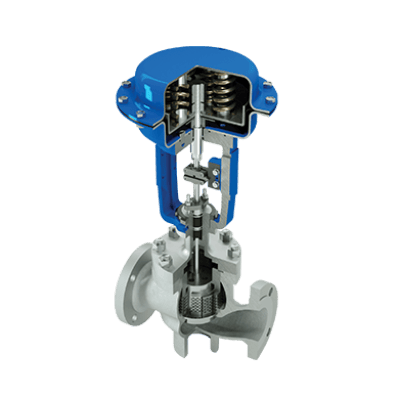
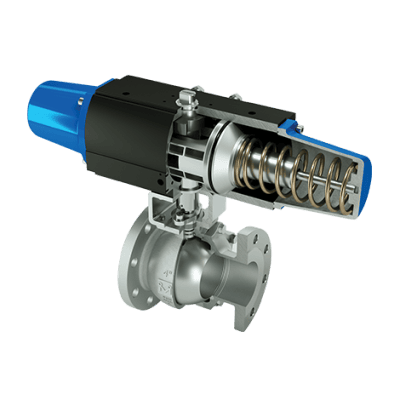
Control Valve Flow Direction has a relationship with a failure action, High Delta Pressure, Cavitation, and percentage opening of valve
The control valves flow direction based on different factors like delta pressure, cavitation, failure action, and percentage of control valve opening
When the fluid passes on top of the plug, it gives a closing action to the plug. This is called the flow to close (FTC) type flow direction. The effects of cavitation are less and it requires more breakaway torque to open and less torque for closing the valve. This is mainly used for low-pressure applications.
Flow to close FTC) is used in anti-cavitation trim with rotary valves are the special applications.
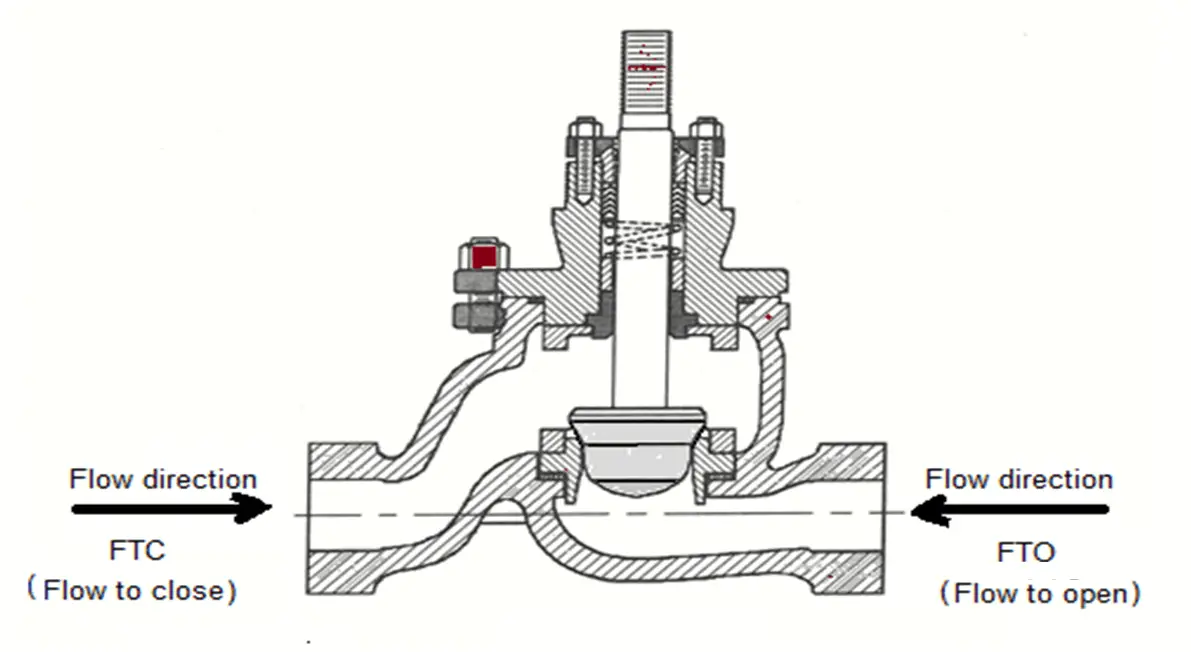
When the fluid flows pass through and faces the plug directly, it gives an opening act to the plug. This is called a flow-to-open (FTO) type of flow direction.
As the flow is upward direction on the plug, it requires higher closing torque and less opening torque and is mainly used for high-pressure applications.
Unless there is a special reason almost all general service applications are Flow to open (FTO).
The flow direction of ball valves is bidirectional irrespective of design such as floating ball or trunnion mounted. On the upstream or downstream, two identical round seats are fixed and the ball will move on it.
Many variables determine which flow direction is appropriate for an application. The style of valve trim, valve (rotary or linear), and the design of the valve all determine flow direction.
Most general service applications are flow to open unless there's a reason to go to flow to close. In rotary valves without a retained seat design, having the flow direction towards the face of the plug assists the seat in sealing against the plug, resulting in tighter shutoff. In globe valves anti-cavitation and low noise trim could be either under or over the seat. Flow to open is generally best for control in low flow applications.
When anti-cavitation trim is required in a rotary valve, flow to close is used so the flow can be diffused rather than flowing into the face of the plug. Balanced trim in a general service globe valve is typically flow to closed. This is normally used in high pressure and/or throttling applications to stabilize the stem. A potential disadvantage of flow to close is reduced flow capacity.
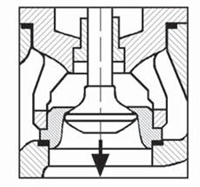
Below is an exception to a classic style flow to open globe valve. The flow direction is NOT against the face of the plug, but behind the plug. This is not flow to close since the plug is located beneath the seat ring. Flow direction is still considered ‘under the seat’ which is causing the plug to open.
What's often confused is that flow to open and flow to close are independent of fail open (air to close) and fail close (air to open) on an air-to-spring diaphragm actuator. The actuator set up will determine whether the spring set will open or close the valve upon removal of air supply. This discussion merely involves flow direction through the valve in relation to the valve plug
 KOMOTO AO-3607 DN150 Control valve maintenance servicesKOMOTO AO-3607 Control valve maintenance servicesTKLD Control Valves ServicesBall Valve Maintenance ServicesGate Valve Maintenance ServicesControl Valve Severe ServiceGlobe Control Valve Maintenance ServicesOn-Off Valve Maintenance ServicesKOMOTO AO-3841 Control valve maintenance servicesKOMOTO AO-3811 Control valve maintenance services